Showing posts with label Primary Source Analysis. Show all posts

Thursday, April 16, 2015

Creating Our Own Seasonal Round to Inform Us as Consumers

Coal River Seasonal Round
Two days ago, I was reading a Teaching with the Library of Congress Blog post about Seasonal Rounds. Seasonal Rounds was a term that I wasn't familiar with, but it is a visual that shows the annual pattern in the production of food. The Library of Congress example showing activities around the Coal River in Southern West Virginia goes further to add in community events and other seasonal events like splitting wood or what animals can be hunted at different times of the year.

I found the visual of the Seasonal Round intriguing. It did an exceptional job of showing the never-ending nature of the work that people do with food production. I also thought the suggestions by Danna, the author of the post, for students to look at yearly family activities could be displayed in an interesting way using the visual.

Jefferson's Vegetable Market Chart
This morning, I read a post from the Library of Congress Inside Adams Blog entitled The President and the Parsnip: Thomas Jefferson's Vegetable Market Chart (1801-1808). In the post, I discovered an interesting primary source, a chart of the typical times fruits and vegetables were at market in Washington. The detail of Jefferson's work reminded me of his weather record, a primary source some students had analyzed earlier this year. But the yearly pattern that he was displaying reminded me of the Seasonal Round graphic that I had looked at just the day before.

My first instinct was to wonder what Thomas Jefferson's chart would look like added to the Coal River Seasonal Round. I knew there may be a geographical issue with looking for overlap though. Then I started to think a little closer to home. I thought of local restaurants in St. Louis that tout their locally sourced foods. I thought of the local grocery stores (1, 2, 3) that advertises locally grown produce items available during the spring, summer, and fall. I thought of the seed packets at home that would be opened in the next few weeks to plant my home garden.

I think there is an interesting science connection here that may even tie into an idea of creating traditions, a variation of what was mentioned in the original Seasonal Rounds blog. We have a grade level that plants a garden at RM Captain. The next school year, another group of students harvest the vegetables that were grown. There is some initial knowledge of the growing season imbedded here in student learning. What if we built upon that?

Starting with Jefferson's Vegetable Market Chart, we could analyze the document to learn that different fruits and vegetables were available to Jefferson at different times. Incorporating the seed packets used by the students when planting that contain information on planting times and growing periods, students could bridge their understanding to connect the availability with the growing season of the fruits and vegetables. That would give us a very local start. From there, we could reach out to  local farms to gain more information on local planting and harvest times or grocers on the typical availability of different local produce. We could then look at the seasonal round to see how these producers tracked their information. Ultimately, we could create our own local Seasonal Round to inform us as consumers. Students would know when local fruits and vegetables are typically available.

With a focus on the health & science curriculum that deals with nutrition, we could even push the idea further. We could look at types of meals and recipes that incorporate those locally grown seasonal fruits and vegetables. We may be able to connect with a nearby restaurant that utilizes local produce to see how they make decisions about their food choices with what is available to them locally.

Ultimately, students could utilize a document from the past to launch learning that impacts choices they make in the present and future. At this point, it is still only an idea, so now it is time to get to work!


Thursday, February 26, 2015

The Lewis and Clark Expedition through Primary Sources

I've written several times about the amazing primary sources that are available online through the Library of Congress. Other great resources that you shouldn't ignore are the local libraries, museums, and historical societies hold primary sources that can help students uncover local history.

You can definitely make the argument that the Lewis and Clark Expedition isn't "local history", but if you visited downtown Historic St. Charles, like our fourth grade, and look at our Missouri-focused fourth grade curriculum, you would understand why most educators in the St. Louis and St. Charles area think of Lewis and Clark as "local".

Last week we had a chance to add to that local feel by incorporating primary sources into student learning that are available at the Missouri History Museum Library and Research Center. Our fourth grade teachers initially asked me about bringing primary sources into the student learning around the Lewis and Clark Expedition. Through a collaboration with librarian Emily Jaycox and Archivist Molly Kodner, we have developed a field trip that highlights essential elements of Lewis and Clark's expedition through the use of primary sources.

Prior to the field trip, experience revolves around the June 20th, 1803 letter from Thomas Jefferson to Meriwether Lewis. I broke the letter up into six parts. Prior to the field trip, students summarized each part in small groups and shared out to the class. The letter gives an incredible overview of the key goals of the expedition as well as how important it was to Jefferson that their findings be documented and copied. The danger of the expedition comes out as well with Jefferson suggesting they bring surgical equipment and providing safeguards for the information in case of their death.

At the Library and Research Center, Emily Jaycox gives an introduction to the Library and Research Center's mission as well as some history of the building. Molly Kodner then shares letters from Meriwether Lewis to William Clark and from Clark to Lewis that were written prior to the expedition. In addition, she shares a letter of credit from Thomas Jefferson for the men on the expedition. They both do an incredible job of introducing the space and setting the stage for the learning. Students are always in awe of the primary sources, especially the letter with Jefferson's signature.

From there, students, divided into groups, rotate through three stations, each one meant to focus on a major element of the expedition.
Molly Kodner shares speech and transcript for students to analyze


Focusing on Native Americans, students analyze a speech read by Lewis to Native American tribes as well as a list of questions posed to the nation tribes. Students groups typically react to Lewis describing the Native Americans as Jefferson's "red children" as well as him asking questions about whether the Native Americans murder each other. Several students perceive the interactions to be disrespectful or inconsiderate on the part of the Corp of Discovery and it is common for students to wonder about how the color of the Native Americans' skin impacts how they are viewed by men on the expedition and others in the U.S.

The focus on maps looked at how these maps were made and how limited resources forced them to be creative in how they documented all of their findings. Students notice how the maps focus on the water ways and discussion by students typically leads to them talking about how people used those rivers as a main means of travel. Students also compare those maps to earlier maps of North America, noticing how much the U.S. and European countries did not know about the land and waterways west of the Mississippi River.

Students investigate ways Clark described flora and fauna

At my station, analyzing the journal entries that focus on flora and fauna, students are first asked to describe Lewis and Clark in one or two words. Typical answers are "Explorers", "Brave", and "Adventurers". I then ask students to look carefully at the journal entries and them to look for evidence that Clark uses observation and description to help others in the U.S. picture these plants and animals in their minds. Students typically point out Clark's use of color, measurement, comparison, description of texture, detailed counting of things like fin points or tail feathers, and location of the animal or plant. If a student doesn't wonder out loud, I usually model the wondering of how they had time to achieve such detail. Students talk about the time it would take to make the detailed drawings,  infer that the animals were killed at some point so that Clark could make such detailed observations, and wonder aloud if animals like the fish described were later eaten. I end by asking other ways Lewis and Clark could be described in one or two words. In our last visit, students described Lewis and Clark as "Scientists", "Writers", and "Artists" and I shared that while we don't talk about Lewis and Clark and the Expedition in science, writing, or art, these men really were all of those things.

Viewing an actual journal from the expedition

While we don't use a formal analysis like the Library of Congress' Primary Source Analysis Tool, students do much more than simply look at these primary sources. They make careful observations, reflect on those observations to come to understanding, and ask questions about the expedition and time period. Most important to me, this experience with primary sources allows thinking and learning that can not happen in any other way. I have not seen a textbook, movie, or web site that leads students to question how Lewis and Clark viewed the Native Americans, to discover how critical mapping the journey was, or to describe these people as artists, writers, and scientists. The use of these primary sources allows student to take their own journey of discovery as they learn about the discoveries of Lewis and Clark.

Friday, February 13, 2015

Testing the Waters: Generating Research Questions through Primary Source Analysis

This post is from an activity that took place during the 2013-2014 school year. It was previously unpublished, but as I have moved forward with the next steps and hope to share those reflections in this blog, I thought this would be a good reference on my students' journey of generating research questions through primary source analysis.

One thing I’ve rarely done is let my students develop their own research questions. I was afraid they would come up with questions that were far off the topic or impossible to answer with our available resources.

After attending the summer institute, I wondered if students could develop their own research questions through using primary sources and the LOC’s Primary Source Analysis Tool. Might it engage the students in their research and allow them to find more of their own voice through their research writing?

I recruited the fourth grade teachers in my experiment. Fourth grade students research a famous Missourian. They answer questions about the person’s childhood, adulthood, and why they are famous. The questions cover the overall person, but aren’t unique to the researcher or the person being researched.

As a trial “famous Missourian”, I chose Ella Ewing, a woman who grew up in Northeast Missouri and was thought to be the tallest woman of her time. She was a sideshow attraction for years at museums and even the Barnum and Bailey Circus.
 
http://www.loc.gov/pictures/item/2002719038/
I chose three primary sources in an effort to look at different elements of Ella’s life. The first was a 1898 Barnum and Bailey circus poster of side-show acts. While it didn’t contain Ella Ewing, these were people she could have worked with. The second was an October 1903 article from the Spokane Press describing Ella as well as other sideshow performers that were appearing at the local fairgrounds. Finally, Students would analyze a photo of Ella Ewing standing next to a chair. My hope was that these three primary sources would bring the students closer to Ella, helping them understand her enough to want to know more.

Students worked in small groups to analyze the primary sources. Magnifying glass in hand, they made observations, reflections, and asked questions using “I see, I think, and I wonder” to frame their statements.

After analyzing the circus poster, I ask students to think about what they would like to know about Ella Ewing after viewing this one connection to her life. They wrote their questions in the Further Investigation section of the Primary Source Analysis Tool.
●      What did she do in the circus?
●      Which circuses did she work for?
●      Did Ella get an offensive “circus” name?
●      I wonder why she would want to do this. (work in the circus)
●      Was she embarrassed about being with these people? (other side show acts)

Even though they knew nothing of Ella Ewing, this poster gave them an idea of her world and made them wonder about her. Their questions reflect that wonder as well as an emotional reaction to Ella’s world. They were beginning to put themselves into her shoes.

http://goo.gl/jEDfbw
Next, students analyzed the newspaper article that mentioned Ella Ewing. They underlined what they saw that was interesting or important to them, wrote reflections and questions. Again, I asked them to think about what they would like to know about Ella Ewing.
●      How tall is she?
●      Was Ella Ewing taller than the Congo Giant?
●      I wonder how much Ella was paid.
●      Did she join the circus for money?
●      Does Ella feel good that she’s not a phoney and some of her crew is?
●      Was she offended to be a circus attraction?

Students read why Ella Ewing was part of the sideshow and it is evident in their questions. Not only did they express their reaction to the second primary source, their questioning about the circus poster evolved as students wondered about the height of Ella and the Congo Giant or compared Ella’s gift of height to what they perceived as other “phoney” sideshow performers.
 
http://www.ruralmissouri.coop/03pages/03MarchElla.html
Finally, students saw the photo of Ella Ewing standing next to a chair. Their analysis was followed by one final chance to ask questions about her life.
●      How did she get so tall?
●      How big was she when she was born?
●      Did she get made fun of at school?
●      Did people stare at Ella?
●      Were people afraid of her height?

With this stark photo, student’s questions are just as stark, but also pointed. The emotional connection continued as students wondered about how others reacted to and treated Ella Ewing.

While not all of these questions can be answered, they do allow student researchers to connect to the person being researched. The answers that students find to other questions provide rich detail that gives depth and unique perspective to a research report.

This experiment may to a larger test. An archivist at the Missouri History Museum, and I have spoken about putting together sets of primary sources around other famous Missourians. I hope that they will also help students develop research questions and connect with the person they are researching.

Saturday, January 10, 2015

Discovering the Person and not the Persona in George Washington through Primary Sources

This past fall I was fortunate to be selected as a Missouri educator who was able to attend a Weekend with George Washington hosted at Mount Vernon. It was an incredible opportunity to rediscover George Washington and the amazing impact he had on not only the early country, but on us today. Several discussions made an impact on me and helped me start to see George Washington more as a person and less as a list of character traits that one might list off for the Father of our Country. I wanted to try to bring some of that to my fifth grade students during their visits to the library as they learned about the formation of the US in the classroom. I also wanted to see how they could use primary sources to help them come to their own discoveries about George Washington.

Finding a starting point was especially challenging. The fifth grade curriculum was a moving target as I looked for resources while students moved forward in their studies. I also needed to select primary sources that were both approachable as well as engaging. Students had to have enough background knowledge to interact with the resource and it had to accomplish that task of understanding the man who was George Washington.

After much searching, I selected the moment George Washington was appointed to lead the Continental Army. In multiple accounts, it states that George Washington, after being selected, refuses a salary and asks for only his expenses to be paid. His gesture at this moment seemed to fit the noble character of George Washington, sacrificing for the betterment of the country. It is also a small moment that is told in multiple books in our library so I consider it part of the lore of George Washington.

But there had to be more to the story. I searched for primary sources that would help me understand this moment and understand the man. What I found surprised me, made me wonder, and expanded my idea of who George Washington was. I couldn't wait to share them with my students to see how they would interpret them.

The lesson started with a blank SmartBoard. I knew students had been talking about the American Revolution. Part of that involved George Washington's role in the war. I asked students to think about George Washington, not only during the Revolutionary War, but throughout his life. "You know a bit about George Washington. I know you've talked about him in class. If you had to use one word or even a short phrase, how would you describe George Washington?"

"Brave" "Courageous" "Strong" "Modest" "Honest" "Leader" "Kind" "Hardworking"

Next, students, in pairs, analyzed the Journals of the Continental Congress for either June 15th, June 16th, or June 17th, 1775 where Washington is appointed to lead the army. It is reported that Washington accepts and states "I do not think myself equal to the command I am honored with," and asks to only be paid for his expenses. On June 17th, the Congress officially appoints Washington. This reinforces what can be found in many other books, but there was more information. Prior to Washington accepting the position, the Congress allowed $500 per month for pay and expenses for Washington. Here we have another piece of information. After sharing their analysis with the rest of the class, I again asked students to share a word or phrase that could describe Washington related to this event.

"Noble" "Put others first" "Humble" "Modest" "Trusted" "Patriot" "Commander in Chief"
All of these continue to fit with the persona of George Washington.

On their next visit to the library, we reviewed what students had discovered about George Washington. Then we looked at several pages of his Revolutionary War Expense Account as Commander in Chief of the Continental Army that was submitted to the Continental Board of Treasury. This is all in his own handwriting and is difficult to understand. To assist students in the analysis of the pages, they paired the page with a corresponding page from a secondary source, a 1917 book by John C. Fitzpatrick where he explains some of Washington's expense account in annotations.

As students analyzed the expense account, many had a noticeable reaction to what they read. I encouraged them to write these reactions down as reflections or questions on the Primary Source Analysis Sheet.

"Why would you need to buy curtains during a war?" "So unnecessary. 217 bottles of wine." "What are 'loaves of sugar'?" "He spent a lot of money." "Why did he get slippers? He's in war right now!"

There was a lot of conversation as students were investing themselves in trying to understand George Washington. Many students looked for justification. Students talked about how life was different and the possibility that drinking wine was more common. One student spoke about how Washington was leading his army for years and would need things other than military supplies. Another pointed out an amount of money that was given to a soldier's wife and reported in the expense account. Students were finding that George Washington was not one dimensional and were trying to make sense of that discovery.

After students finished their analysis, I shared a final secondary source from the National Archives showing the amount that George Washington incurred during the American Revolution, $160, 074. To more fully understand the number, I shared with students that there were large expenses for spies as well as supplies and materials for other soldiers, something not likely taken into account by the Continental Congress initially. Many students recalled the initial $500 monthly allocation suggested by the Continental Congress and that it was far exceeded by the amount George Washington spent over approximately 8 years.

I believe there was much more we could have uncovered about Washington with this activity, but our time was limited. I asked students, one final time, to share a word that could describe George Washington based on what we had analyzed that day.

"Smart" "Wise" Clever" "Not Wise" "Rich"

Given what students had analyzed, I think all of these traits are fair. More importantly, I think they are not all traits that typically fall under the persona of George Washington. Students had begun to look beyond that persona to understand and describe the person. In the meantime, students had investigated and analyzed papers dealing with the Continental Congress and the Revolutionary War. Overall, I think this first investigation into George Washington was a success and I look forward to students building on it in future activities.

Friday, December 12, 2014

How Using Primary Sources in Science Helped Me Reshape My Definition of Primary Sources

Meetings with my librarian colleagues are usually quite amicable. Except when it comes to what makes something a primary source. Then the clashes start. I'm not kidding. There have literally been arguments where voices are raised as we've wrestled with this question as a group. I thought about those lively discussions when I recently realized that my own definition for what makes something a primary source had changed.

For the last couple of years, I had used two resources to shape my definition of a primary source. The first is from the Library of Congress. One description it gives is that primary sources are "original documents and objects created at the time under study." It also goes on to read that "They are different from secondary sources, accounts or interpretations of events created by someone without firsthand experience." The second source contradicts that somewhat. In a podcast episode from Creative Learning Factory, they focus on newspapers being a primary source. With many articles not being written by someone with firsthand experience, can we consider these primary sources? The podcast takes the position that "primary sources are either an eyewitness account or an artifact of its time." To me, if I wanted to know what a greater community would know of an event, a newspaper article would qualify as a primary source of that question.

Earlier this year, the students did an activity where they analyzed primary sources of scientists notes and writings to investigate how they organize their work and their thinking. The sources were from all different time periods and a variety of scientists. Students recognized organizational strategies of these scientists and connected them to their own writing as elementary student scientists.

During other activities where I had utilized primary sources with students, there was a focus around a date, year, or range of time. We used primary sources to focus on colonial times, the building of a American symbol, or the time when a famous individual was alive. There was a beginning date and ending date. Even when we would focus on events like Thanksgiving or Halloween, the date would be important. What was Thanksgiving like 70 years ago? How did they celebrate Halloween 100 years ago? I could even attach specific dates to these types of investigations, and more importantly, many times the dates were important for us to compare our lives with those of others or to put it into a chronological context for our understanding.

With our activity about scientists and their notes, that specific date didn't seem to matter. Instead, the moment in time mattered, that moment when the scientist was writing down his or her ideas, questions, or observations. While we had information on when those moments took place, they weren't important to the analysis of the primary source or the understanding that they were working to come to. Students didn't need the date that Alexander Graham Bell wrote about his experiment to come to understand how he decided to record his ideas and they didn't need to know the year that Leonardo da Vinci drew illustrations of a bow to compare his method to theirs.

Is this new viewpoint unique to using primary sources in certain science settings? I don't think so, but it was what moved my thinking forward. I think the same idea of a primary source not being attached to a date, but a moment in time would apply in the work our fifth graders have done when using primary sources to define geocentric and heliocentric models of the solar system. What made those resources primary sources in that case wasn't the year they were created (although you could have done another activity with that being an important factor) but that these images were products of moments when these scientists were creating or defining either a geocentric or heliocentric model of the solar system.

I realize that this original misconception was not caused by a faulty definition by the Library of Congress or a misspoken idea in a podcast. It was my interpretation of those things that was flawed. To me, that word "time" in the definitions originally meant that date or date range or era. What I failed to think about was about "time" as "moments" Those moments could be scattered over years, decades, or centuries. And artifacts could have been created in all of those moments that are connected, not by the date, but by the activity or intention by the creator of the artifact at that moment. 

I'm sure that my working definition of a primary source will continue to evolve over time. For now, I am looking forward to that next spirited discussion with my fellow librarians.

Monday, December 1, 2014

Taking Notes Like a Scientist: Using Primary Sources to Examine Note Taking Strategies

Last summer, I participated in the Library of Congress Science Seminar, a five day professional development opportunity that allowed me to begin exploring the integration of primary sources as a resource in science instruction. As part of that week, I made a plan on one way to integrate primary sources with the direction to implement the lesson during the first half of the school year.

My idea for a lesson revolved around science note booking and note taking in our school. In 3rd grade, our science teacher introduces the process. It continues through their elementary career. During a book study last year on research, using Chris Lehman’s book “Energize Research Reading and Writing”, I saw many correlations between the free form style that students use when science note booking and the introduction to note taking styles with student choice based on need emphasized in Lehman’s book.

I saw them as two styles that could complement the other. My question was how to bridge the gap between the two. While at the Seminar, I decided primary sources might be the answer. Through the use of primary sources, students could connect their own natural tendencies to organize information through science note booking with tried methods to organize information that scientists have used in the past. Instead of teachers demonstrating note taking methods, students would discover the note taking methods of actual scientists and attempt to incorporate those methods into their own note taking. These methods could transfer into note taking in other subject areas as needs arose.

During the first week of school, third grade students participated in the note booking emersion. They observed fish, plants (and all of the insects on them), and other scientific phenomena. During their excursion, many students saw some type of small eggs on melon leafs in the school garden. This caused a lot of excitement and speculation. The classroom teacher had a naturally generated question and we decided to run with it. Students would do a mini research project trying to answer their question and I would help them think about their note taking in the process.

http://www.loc.gov/item/magbell.25300102/    
Students began their study of scientists’ notes by analyzing a page from a notebook of Alexander Graham Bell. Students used a modified version of the Primary Sources Analysis Tool from Library of Congress. For the purposes of this lesson and because of time restrictions, I wanted students to focus in on what they saw as an organizational tool (Observation) and why they thought the scientist organized his information in this way (Reflection). 

Students found a great deal of organizing methods. Pages were numbered, ideas were dated and sorted into short paragraphs. There were drawings of Bell’s telephone that was labeled with letters and those corresponding letters were used in his writing about the device. And in each method, students were able to give some reflection as to the “why” of its use. “Short paragraphs are easier to read.” “If you date things, you’ll know what order you did them in.” “Labeling the picture and using the labels in his writing helps me understand what he is writing about.”

Smaller groups then continued by analyzing another note or recording method of a scientist. Students analyzed the directions for using a macaroni machine written by Thomas Jefferson. They explored the drawings for a crossbow by Leonardo da Vinci. Students even looked at more recent notes by Dave Morrison as he thought about measuring the surface temperature on Mars. 

In these other works, students noticed drawings done from different perspectives, underlined and circled words, tables, step by step directions, and different ideas for the same goal drawn side by side. In each case, students were, again, able to express an idea about why the scientist chose to organize his thinking in that way. “It makes it easier to read.” “This was probably really important.” “You can see different details when he draws it this way.”

We extended the activity by asking students to look at their initial writing and drawing from their note booking experience. Could they see similarities between their work and the work of the scientists? They shared example after example, further reinforcing themselves as scientists and their work as scientific. I also feel they saw the work they do in a school setting existing outside of and beyond school. This skill was important and was used by great minds! Finally, I asked them, “As you take more notes, either from observations or from reading or viewing images, what strategies did these scientists use to organize their information that could help you?” Many shared ideas directly from their findings through the primary source analysis.

As they moved forward with their study, I did revisit their second set of notes and there were definite similarities between their work at the scientists’ work they studied.  My hope is that this has laid a foundation and gives examples to call back to as students continue to explore note taking.


note: For anyone trying something similar, I will share that I did have to make transcripts of much of the notes because of the cursive handwriting. While students were willing to make attempts, the struggle would have slowed down the activity too much.

Wednesday, November 19, 2014

My Favorite Thanksgiving Primary Sources

This week really starts the Thanksgiving season for me. The five class days before the Thanksgiving break, the students and I do different kinds of Thanksgiving activities. Really, we analyze and investigate all kinds of Thanksgiving primary sources, kindergarten through fifth grade.

I know this might not sound like fun, not compared to crafty activities or reading a great Thanksgiving picture book. I would argue that it is better though. I see it as a discovering of knowledge about Thanksgivings past. In each grade, we focus on a different primary source or set of primary sources, and we don't just analyze them. We try to go further. This is something that I try to emphasize with my students. What do you do with that knowledge about the primary source you just analyzed? What can you connect it to? How can it help you look at something else in a different way?  How can you use it to compare life now to life at another time? For this set of activities, we typically talk through this. In other activities, we may write or illustrate. With the excitement that leads up to Thanksgiving break, the students often want to talk, so I take advantage of that.

I thought I would share my favorite Thanksgiving primary sources.

http://www.loc.gov/pictures/item/ggb2004010001/
Kindergarten students will be analyzing a wonderful photo from 1911 of students in a schoolyard titled
School Children's Thanksgiving Games. In the photo, some students sit on a bench watching other students who are in different Thanksgiving costumes. My favorite find in the photo, a child wearing a turkey mask, hasn't been seen by a student yet. See if you can find it.
After analyzing this photo, students compare these students celebrating Thanksgiving to their school celebrations at RM Captain.

In first and second grade we move the celebration from school to home and analyze photos from the Crouch family's Thanksgiving taken in 1940. These twenty photos are a wonderful snapshot of a Thanksgiving day in a large family's home. While the photos don't individually contain the detail that
http://www.loc.gov/pictures/item/fsa2000023954/PP/
the 1911 school photo does, as a group, they are rich with information about culture and tradition.
In first grade we will focus in on a photo of Mrs. Crouch pouring water on the turkey, the photo of the pies with the family visible in the mirror's reflection, and the photo of the whole family eating with the children at a separate table. Students will fully analyze one of the photos with the Observe, Reflect, Analyze model (using I see, I think, and I wonder) and do a lighter, quicker analysis of the others where we focus in on only what we see. Similar to kindergarten's comparison to school, first grade students compare their home celebrations to the Thanksgiving celebration in the photos.
In second grade, students will analyze several photos in groups, focusing their analysis on where events are taking place in the photos. In groups, they will attempt to create a map of the Couch's kitchen where the meal was cooked and eaten, highlighting furniture and other points of interest from the photos in their map.
http://chroniclingamerica.loc.gov/lccn/sn89081022/1922-11-22/ed-1/seq-5/

Third grade students are going to be building on the first grade idea of the Thanksgiving meal
traditions and be planning their own Thanksgiving meal with a primary source twist. The class will collaborate on items for the meal and then shop in two places. Two groups will use a current local grocery store advertisement. Two other groups will use newspaper advertisements from about 90 years ago. The two advertisements, the first from 1919 and the second from 1922, list many items that students may use today. I'm eager to see if it does the job. While we won't be doing a traditional analysis on these pieces, I'm looking forward to the math and problem solving connections.

http://www.loc.gov/pictures/item/ggb2004010002/
Fourth grade students will work with my favorite Thanksgiving primary sources. Earlier this year, our fifth grade classes did a primary source analysis to learn about a lost Halloween tradition. Our fourth graders will learn about a lost Thanksgiving tradition. They will first analyze a hundred year old photo of Thanksgiving Maskers, a group of boys dressed in costume who look like they are more fit for Halloween night. Following their analysis, which may leave more questions than answers, they will read a newspaper editorial from the same time period where the writer shares her distain for the maskers tradition of walking down the sidewalk banging pots and blowing horns, and asking passersby for pennies or candy while families are trying to enjoy their Thanksgiving. Learning about this lost tradition gives students a chance to be historians and investigate the a tradition completely foreign to them.

http://www.loc.gov/pictures/item/2004660226/
Finally, in fifth grade, students will be looking at Thanksgiving officially being named a national
holiday with Lincoln's 1863 proclamation while analyzing an 1861 drawing of Civil War soldiers celebrating Thanksgiving in camp. Hoping that students see that Thanksgiving was being celebrated before being named an official holiday, they will then use a secondary source to give them an overview of other presidents making Thanksgiving proclamations going back to George Washington.

I'm looking forward to this week with students before Thanksgiving, not just because of the great primary sources that they will be interacting with. I'm also looking forward to the K-5 experience throughout the entire building all connecting back to different learning around Thanksgiving as well as the potential experiences that students have year after year with these primary sources.

Friday, October 31, 2014

When Primary Sources do Double Duty OR When Halloween and Politics Collide

Earlier this week, I posted about a primary source analysis that a class of fifth graders did. The focus was on lost traditions, specifically, the lost superstitions of doing certain activities to find your spouse on Halloween. We used an 1896 drawing along with a newspaper article to uncover the lost superstition of looking at a mirror holding a candle to look for the image of your future spouse. Through my own analysis and with the help of some others, I found out quite a bit more about the drawing and the intention behind it.


Through the analysis of the 1896 drawing, many students focused on the dress of the woman shown. Her top is covered with stars, the bottom with stripes, giving it a flag effect that is difficult to ignore. She stands at a dresser and mirror, her hand on a candle. There is a reflection of a man in the mirror.  The man shown in the reflection isn't the dashing young man that one might expect to be shown in the representation of this superstition. Four days ago, when I found the newspaper article that referenced the superstition, I was just happy that I had some understanding of the image.

http://www.loc.gov/pictures/item/2011645580/
Then, another layer of the drawing started to reveal itself. First, an educator in the TPS Teachers Network that I am a part of shared a similar image. This one referenced the tradition in a satire of the 1904 election. In the image, Uncle Sam is walking down the stairs holding a candle and a mirror. In the mirror is the image of Teddy Roosevelt. In the background, other candidates walking around with candles and mirrors looking for their "match". I wondered about the woman in stars and stripes from the other picture, but hadn't put together the pieces yet.


That afternoon, another fifth grade class came in for the activity. The teacher was very active and
http://en.wikipedia.org/wiki/United_States_presidential_election,_1896
jumped right in to do the analysis of the drawing with the students. As students read the newspaper article, I asked if she had ever heard of this superstition. She shared that she hadn't, but it made her wonder more about the questions that she had written as part of her analysis and wondered aloud if there was an election in 1896. Everything clicked into place for me. I shared a little about the other picture and she quickly looked up information on the 1896 election. There, on wikipedia, was an image of William McKinley which bore a eerie resemblance to the "ghostly" image in the mirror from the 1896 drawing. We were left with a new interpretation, that of Lady Liberty looking for her future spouse.

There I discovered a whole new meaning to this 1896 drawing. It was the political satire of the day. The 8th grade social studies teacher could use this in studies of the late 1800's. The high school political studies teacher could pair these images with more current political cartoons involving Halloween traditions. Either class could explore the illustrator's intended audience. Those aren't areas that I would explore with fifth grade students, but them learning the tradition could give them key background knowledge if revisiting the primary source later.

In addition to the many places this primary source could work among different grade levels, the collaboration to get to meaning is worth noting. I made my own learning discoveries with the help of colleagues. Without them, I would never have discovered that deeper meaning to the 1896 drawing. Similarly, students benefit when discussing primary sources together. Their thinking is stretched and challenged. Pieces of understanding from multiple students can be put together to deeper meaning than they can achieve alone. While it may not be appropriate to constantly have students collaborating during the analysis of a primary source, having them come together at different points in the process can reap great benefits.

Tuesday, October 21, 2014

Adapting Text-Based Primary Sources for Elementary Students

I was excited to see that the fifth grade teachers at RM Captain are integrating primary sources into some of their history teaching. Some challenges they were facing in using text-based primary sources and how they are addressing those challenges is worth sharing. Text-based primary sources can include letters, journals, diaries, laws and government records, newspapers, speeches, transcripts of interviews, or any primary source where text is the main component.

In a recent collaboration with the fifth grade teachers, they were excited to share an activity that relied on primary sources on the topic of the Jamestown colony for students to make decisions about founding their own colony and, in the process, come to some understanding of why cities and towns were initially located in certain places.

The teachers shared their resources with me. They had a number of text-based primary sources. I was interested to see how the students interacted with them, so I asked Mrs. Ketzer, one of the teachers, how the project was going.

Mrs. Ketzer shared that she didn’t think the students were connecting with the primary sources and that they were struggling with them. She shared that they were using the same process of making observations, reflections, and questions that we had done in the library with other primary sources. 

We spoke about the primary sources that they used. Some of them were longer texts. Even shorter texts had difficult vocabulary. All of the primary sources were transcribed, but were copies of copies with black print on grey background. Through our discussion, we came up with several ideas to present the primary sources in a way that may help the students connect with them more effectively.


  • Retype the text so that it looked more clean and was a little larger. It would be easier to read. Removing distractions allows students to focus.
  • For longer passages, choose chunks that are important for students to analyze. While older students may be able to read and analyze a large passage, younger students can be more successful with shorter passages. Choose the piece(s) you hope they would focus in on. Isolate them and let students interact with them.
  • Provide a glossary on the same page, allowing students to understand the text without leaving it. Text written even a few decades ago may have words or phrases that students have never seen. Reading around the text in a small passage may make it difficult or impossible for them to come to an understanding of the text or it may be confusing.
  • Provide space for students to make reflections and questions on the same page. (With text based primary sources, we typically make observations right on the copy of the primary source.) Having the source and analysis in the same place allows easy access when using their thoughts for the next steps of learning.


The next day Mrs. Ketzer shared a new version of the primary source text. I thought she did an excellent job of implementing our ideas. I suggested a few changes to wording, and she began using it with students. 


I checked in with her and Mrs. Crowley, the other 5th grade teacher doing the simulation with her students, a few days later to see how the updated presentation of the primary sources were going. They both felt students were much more engaged with the text. One student, who was close by and listening to our conversation added, “It’s so much easier to read.”


As we present primary sources to students, it is not only important to choose the best primary source for students to analyze, but also to present the primary source in a way that encourages a student to engage and interact with it.

As I was writing this blog post, I found this article on making text-based primary sources more accessible for students. You may find it an interesting addition.

Sunday, October 5, 2014

Taking Chistopher Columbus' Journal One Step Further

Years ago, when I was still in the classroom, we used translations of Christopher Columbus' journal in class. I read it to students or they read it on their own. They took on the role of a shipmate and wrote their own journal entry. It all felt "okay" but was missing something. I think a recent activity with two fifth grade classrooms got closer to meaningful learning.

During collaboration, two of our fifth grade teachers were studying the time period encompassing European exploration. They wanted to push their own teaching forward and had collected many resources on the typical explorers that students study. Since I have been doing several activities with primary sources, they asked if I would do an analysis of Columbus' journal entries with the students. They handed me a packet of journal entries. I agreed that we could do something with the entries.

 I knew we were under time limitations, less than two hours. They were coming to the library during one of their social studies periods. If I needed more time, I could take their weekly library visit as well. That time limitation always shapes our encounters with primary sources. Here, I knew I had to put specific journal entries in front of them. I chose three that I thought revealed Columbus' intentions better than the others. In one entry from October 12, 1492, he writes about meeting natives and taking possession of the island. In another from that same day, he writes about his desire to convert the natives to his religion. In the final shared entry from October 13, 1492, Columbus writes about his search for gold.

I had three entries that highlighted intentions that would impact Columbus' and other European explorer's encounters with Americans, but I was left with a feeling of "so what?" Students could analyze these writings and come to some understandings about Columbus and possibly those that he encountered, but what would allow them to solidify their thinking in action? This is another understanding that I've come to when using primary sources with students. While analyzing using the LOC Primary Source Analysis Tool is a powerful activity, there is a piece at the bottom that reads "Further Investigation". It challenges us to take that next step with students and not to let the analysis be the end of the learning.

http://www.loc.gov/pictures/resource/cph.3a10998/
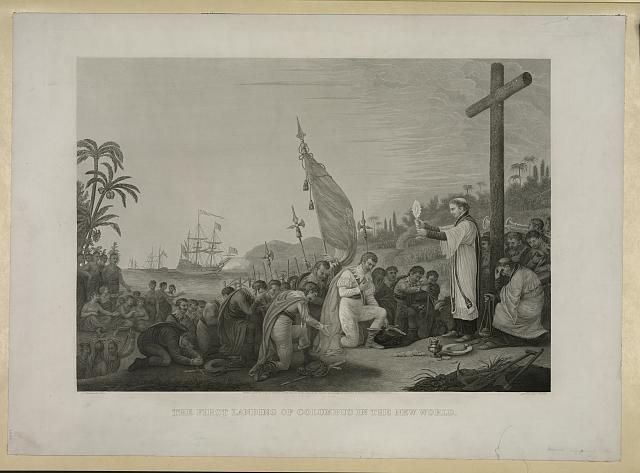
Again, I turned to primary sources. I thought about a piece of artwork depicting Columbus' landing that was used in a summer institute at the LOC that I attended in 2013. It was created in 1893, hundreds of years after Columbus' landing. We originally used it in a discussion where we began to form our definition of a primary source.

The interesting thing about the piece is that it seems to be influenced by the time period of when it was created and its creator. (I encourage you to read Rebecca Newland's ideas on sourcing and contextualizing.) Critiquing a interpretation of Columbus' landing based on his own words would provide an opportunity for students to show an understanding of the journal entries and apply that understanding to their critique.

http://www.loc.gov/pictures/resource/cph.3g04806/
I chose three different artist renditions of Columbus' landing. I felt they had three distinct perspectives and would allow the students to focus on different perspectives of the journal entries. My resources were ready.

http://www.loc.gov/pictures/resource/pga.01974/
Students, overall, did an incredible job on the analysis of the primary sources. I like to keep my directions simple, telling students to identify anything they think is important, interesting, or unusual. There is also a warning of not thinking everything is important, interesting, and unusual. Many reflections and questions spoke to the perspective of the natives, letting me know that they were identifying Columbus' perspective, but not solely identifying with that perspective. With some delays, we completed analyses of two of the journal entries in our first sitting. As students left, one said, "Thanks, that was fun," while I overheard another telling a fellow classmate, "I did the third analysis already even though we weren't supposed to." These were two small signs that we were on the right track.


During the students' next visit, we jumped back into the activity with them analyzing the third journal entry. After they finished this, I paired them up and gave them their final challenge. I told them I had three depictions of Columbus' first landing in the new world. They were all made after this journey and I wanted them to choose one that, based on what they knew, Columbus would say was the most accurate.

Students were up for the challenge and the conversations were interesting to overhear. Students argued over elements in each picture, not only identifying connections between the images and the journal entries, but giving them weight about what was most important to see in the interpretation. One image showed men in armor which was in the journal, but is also showed natives there when they shouldn't be (according to this student's interpretation). Faith was written about, but not crosses which were shown in two of the images. One image truly had natives without clothing but was missing other elements a student felt was important. Ideas were swirling, not only in heads, but also in the air.

I stopped the conversation. I wanted students to make an individual decision and defend it. I asked all students to make a "claim" and "evidence" statement. I see these used more in science, but thought that this would work well here, not only because they were familiar with the format, but because it
would allow them some structure to their choice. I gave them some guidance on what they may want to write about, not only what they felt made their choice the best according to Columbus, but also what made the other options not as good. With less than ten minutes, they quickly shared their thoughts.

While I am still reading the student responses, I am seeing much of the opinion that I heard in the discussion and evidence that they took their analysis of the journal entries and were able to apply it to critique the artistic depictions.